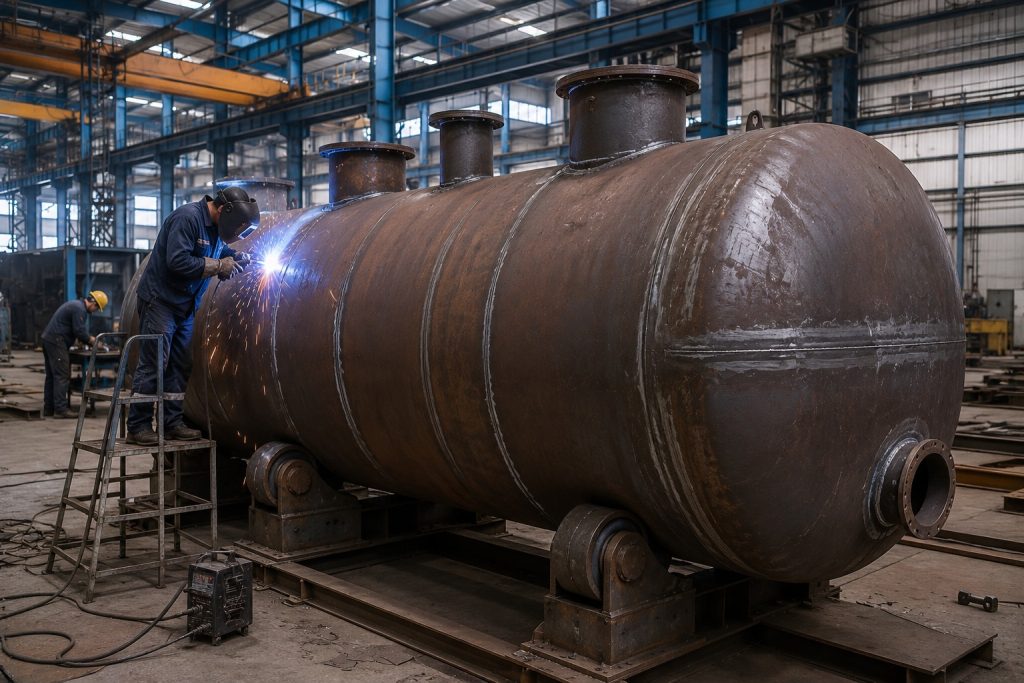

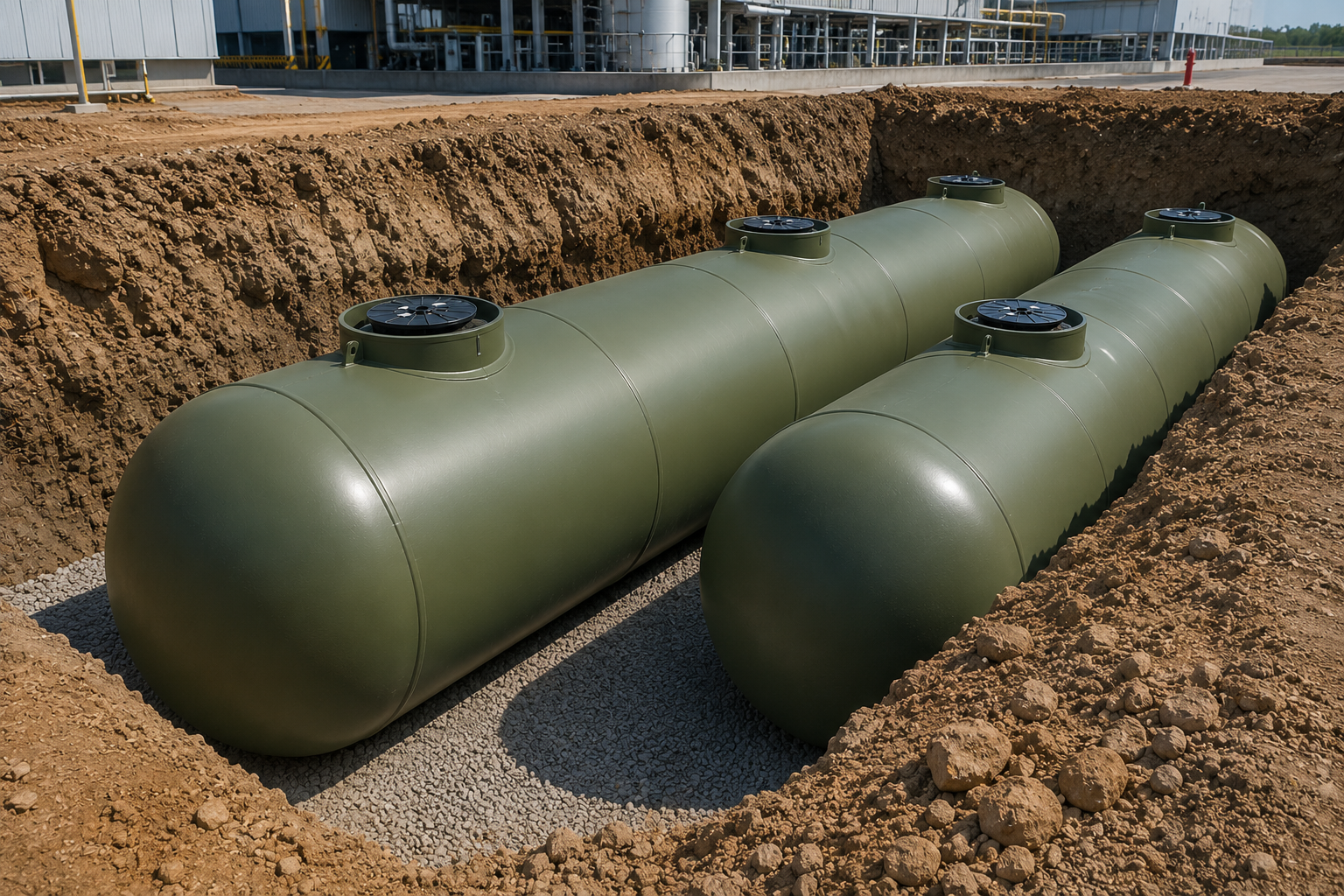
The capacity of an underground storage tank is calculated by determining the volume of liquid the facility needs to store and then selecting appropriate tank dimensions. For industrial applications, capacity depends on daily consumption, process requirements, fire-water demand, emergency storage, operating cycles, rainfall collection, and future expansion.
A basic rectangular tank volume can be calculated using:
Tank Volume = Length × Width × Effective Water Depth
For example, a tank measuring 10 m × 5 m × 3 m has a gross geometric volume of:
10 × 5 × 3 = 150 m³
However, the usable storage capacity may be lower because of freeboard, internal arrangements, and operational requirements.
Why Is Correct Tank Capacity Important?
An undersized tank may not provide sufficient storage during peak demand.
An oversized tank, on the other hand, can increase:
- Construction cost
- Excavation requirements
- Material consumption
- Maintenance requirements
- Land development complexity
Therefore, tank capacity should be based on actual project requirements rather than simply selecting the largest possible tank.
What Factors Determine Underground Storage Tank Capacity?
1. Daily Water Consumption
For industrial water storage, estimate the facility’s average and peak consumption.
Consider:
- Manufacturing processes
- Cleaning
- Cooling
- Sanitation
- Utility requirements
- Employee consumption
- Other water-dependent operations
2. Peak Demand
Average consumption does not always represent the required storage capacity.
Production schedules, seasonal demand, and operational peaks should be considered.
3. Fire Water Requirements
If the tank is intended for fire protection, the required capacity should be determined according to the applicable fire-safety design and the facility’s risk profile.
4. Emergency Storage
Some industrial facilities require additional water reserves for periods when the main water supply is interrupted.
5. Future Expansion
If the facility is expected to expand, the storage system can be planned to accommodate future demand where economically and technically practical.
How Do You Calculate Rectangular Tank Capacity?
The basic formula is:
Volume = Length × Width × Depth
Suppose an industrial facility requires a tank with:
- Length = 12 m
- Width = 6 m
- Effective depth = 3 m
Then:
12 × 6 × 3 = 216 m³
Since 1 cubic metre equals 1,000 litres:
216 m³ = 216,000 litres
This is the geometric volume. The final design should account for freeboard, usable volume, and structural considerations.
How Do You Calculate a Circular Tank?
For a cylindrical tank:
Volume = π × r² × h
Where:
- r = internal radius
- h = effective liquid height
For underground industrial applications, the final geometry should also consider excavation constraints, structural design, and site conditions.
What Is Freeboard in an Underground Storage Tank?
Freeboard is the vertical space provided above the normal operating liquid level.
It helps accommodate:
- Water movement
- Operational fluctuations
- Safety requirements
- Inlet flow
- Preventing overflow
The required freeboard should be determined during engineering design.
Should Tank Capacity Include Future Expansion?
If future expansion is expected, engineers can evaluate whether additional storage should be incorporated into the initial project.
Planning for expansion early can be more economical than rebuilding the entire storage system later.
What Information Is Needed Before Calculating Tank Capacity?
A proper capacity assessment should consider:
- Type of liquid
- Required storage duration
- Daily consumption
- Peak demand
- Emergency requirement
- Fire-water requirement
- Site area
- Available depth
- Groundwater conditions
- Future expansion
- Applicable regulations