
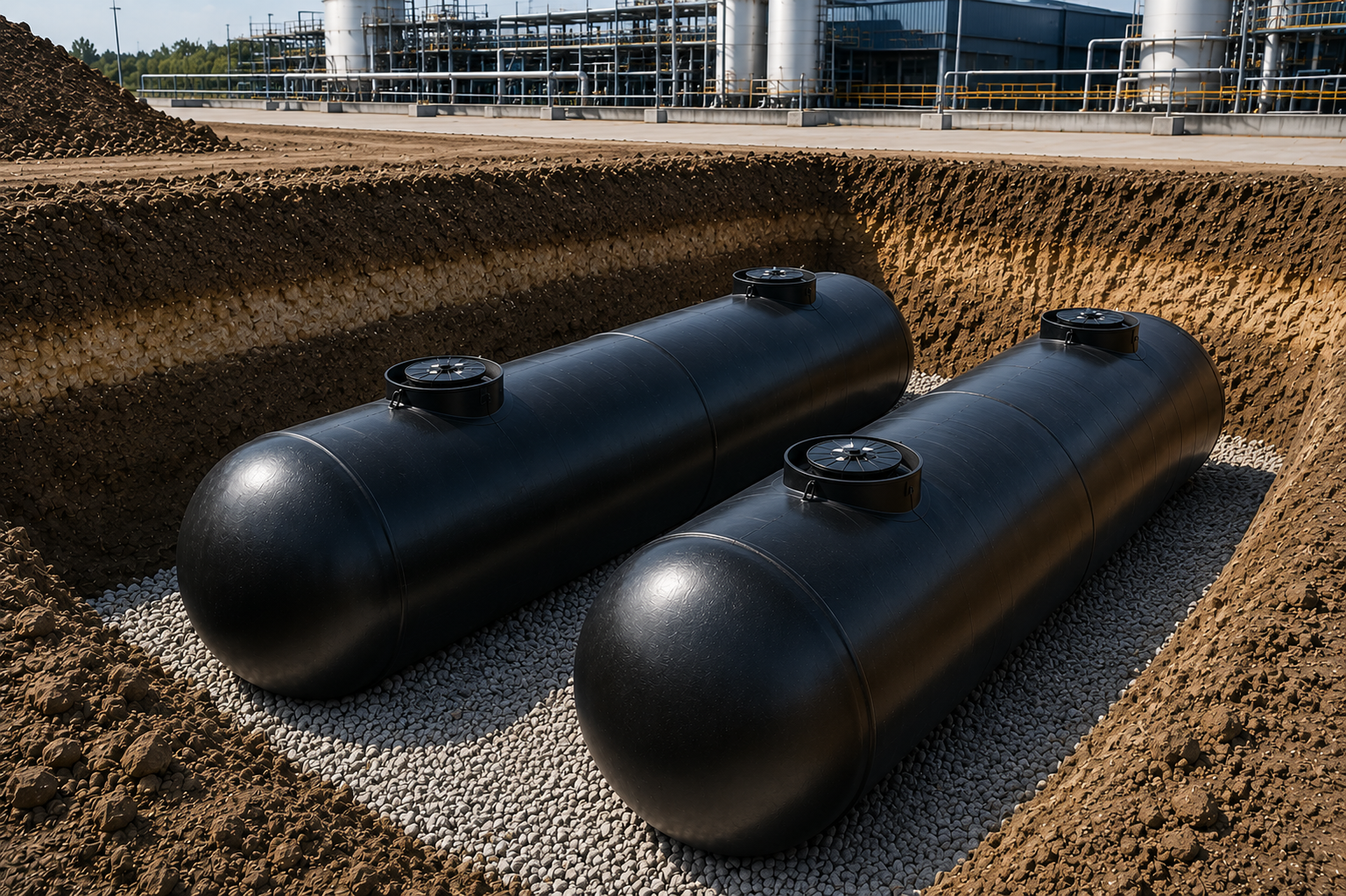
Soil and ground conditions are critical when installing an underground storage tank because the tank must withstand earth pressure, groundwater pressure, structural loads, and potential ground movement.
Before construction begins, the site should be investigated to understand soil properties, groundwater levels, bearing capacity, and other subsurface conditions.
Why Are Soil Conditions Important?
Unlike an above-ground tank, an underground tank interacts directly with the surrounding soil.
The soil can influence:
- Foundation performance
- Excavation stability
- Tank settlement
- Lateral pressure
- Groundwater pressure
- Waterproofing requirements
- Uplift risk
- Backfilling requirements
Poor assessment of these factors can lead to structural or waterproofing problems.
What Soil Conditions Should Be Checked?
1. Soil Bearing Capacity
Engineers need to understand whether the soil can safely support the tank and associated loads.
Low-bearing-capacity soil may require additional foundation or ground-improvement measures.
2. Groundwater Level
A high groundwater table can create significant external pressure around the tank.
It can also generate uplift forces, particularly when the tank is empty or partially filled.
3. Soil Type
Different soil types behave differently.
Engineers may need to evaluate:
- Clay
- Sand
- Silt
- Gravel
- Fill material
- Rock
Each can have different drainage, settlement, and bearing characteristics.
4. Settlement Potential
Uneven settlement can place additional stresses on the tank structure and connected pipes.
Uniform and differential settlement should therefore be considered during foundation and structural design.
5. Excavation Conditions
The stability of excavation walls must be evaluated before construction.
Depending on soil conditions and excavation depth, appropriate temporary support or safety measures may be required.
How Does Groundwater Affect an Underground Tank?
Groundwater can create pressure against the tank walls and base.
When the tank is empty, groundwater may also create an upward force.
This is known as buoyancy or uplift.
The engineering design must therefore verify that the tank remains stable under relevant groundwater conditions.
What Is the Importance of Backfilling?
Backfilling is the process of placing suitable material around the tank after construction or installation.
Poor backfilling can result in:
- Uneven pressure
- Settlement
- Damage to waterproofing
- Voids around the tank
- Structural stress
Backfill material and compaction should follow the project’s engineering specifications.
Should a Geotechnical Investigation Be Conducted?
For significant industrial projects, a geotechnical investigation is highly valuable.
It can provide information about:
- Soil profile
- Bearing capacity
- Groundwater
- Settlement characteristics
- Excavation conditions
- Soil aggressiveness
- Foundation recommendations
This information allows the structural and civil design to respond to actual site conditions.
How Can Soil Conditions Affect Tank Cost?
Ground conditions can significantly influence project cost.
For example, difficult soil or high groundwater may require:
- Additional excavation measures
- Dewatering
- Ground improvement
- Stronger foundations
- Waterproofing systems
- Additional structural reinforcement
- Special backfilling procedures
Therefore, underground tank cost should not be estimated only from tank dimensions.