

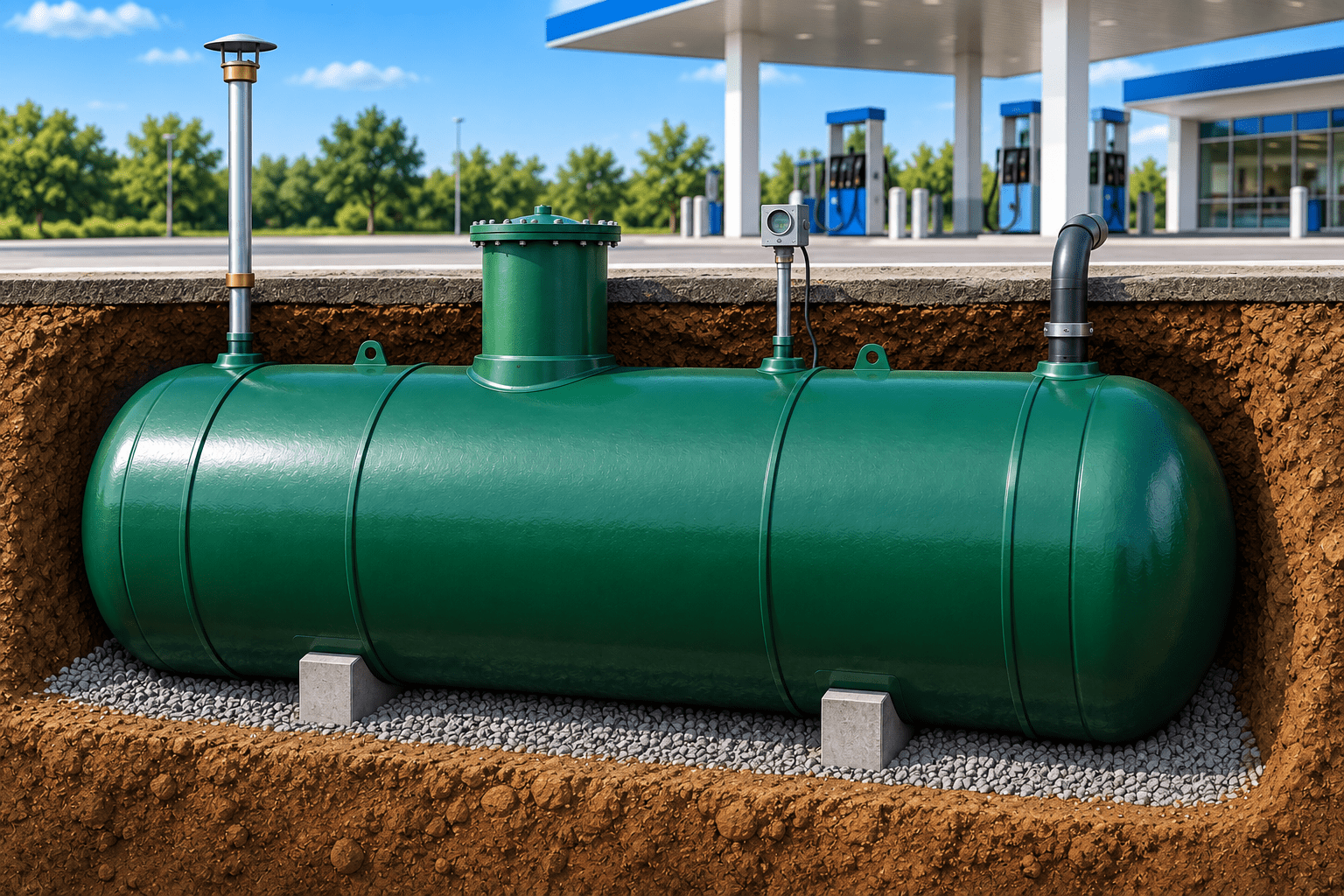
Underground fuel storage tanks are used to store petrol, diesel and other fuels below ground level. They are widely used at petrol stations, industrial facilities, commercial properties, logistics centres and fleet operations.
However, not every underground fuel storage tank is the same.
The right tank depends on factors such as the fuel being stored, required capacity, environmental conditions, corrosion risks, site requirements and project regulations.
Quick Answer: What Are the Main Types of Underground Fuel Storage Tanks?
The main types of underground fuel storage tanks are generally classified based on:
- Tank construction
- Number of walls
- Material
- Fuel storage application
Common options include single-wall tanks, double-wall tanks, steel tanks, and composite or compatible alternative tank systems.
1. Single-Wall Underground Fuel Storage Tanks
A single-wall underground fuel storage tank has one primary tank wall separating the stored fuel from the surrounding environment.
Advantages
- Simpler construction
- May be suitable for certain applications
- Potentially lower initial system cost
Considerations
Single-wall tank systems require careful consideration of:
- Environmental requirements
- Monitoring requirements
- Corrosion protection
- Site-specific regulations
For modern fuel storage projects, the required level of containment and monitoring should always be evaluated before selecting a tank system.
2. Double-Wall Underground Fuel Storage Tanks
A double-wall underground fuel storage tank includes a primary tank and an additional containment layer.
The space between the walls can support interstitial monitoring in systems designed for this purpose.
Advantages
- Additional containment layer
- Improved monitoring possibilities
- Can provide an additional level of protection
Applications
Double-wall underground fuel storage tanks may be considered for:
- Petrol stations
- Commercial fuel storage
- Industrial facilities
- Environmentally sensitive locations
3. Steel Underground Fuel Storage Tanks
Steel has traditionally been used in underground fuel storage tank construction.
Steel tanks offer structural strength but require appropriate corrosion management because underground environments can expose steel to moisture and corrosive conditions.
Important Considerations
Steel underground fuel storage tanks may require:
- Protective coatings
- Corrosion protection
- Cathodic protection where appropriate
- Regular inspections
- Monitoring
The suitability of a steel tank should be evaluated based on project-specific requirements.
4. Fibreglass or Composite Underground Fuel Storage Tanks
Some underground storage systems use non-metallic or composite construction materials.
These systems may offer different performance characteristics compared with traditional steel tanks.
Potential Advantages
Depending on the product and application, benefits may include:
- Resistance to certain forms of corrosion
- Different weight characteristics
- Suitability for specific site conditions
However, fuel compatibility and project requirements should always be verified before tank selection.
5. Underground Diesel Storage Tanks
Underground diesel storage tanks are designed for diesel storage applications.
They may be used for:
- Generator backup systems
- Industrial machinery
- Fleet operations
- Logistics facilities
The capacity and fuel transfer system should be designed based on expected consumption and operational requirements.
6. Underground Petrol Storage Tanks
Petrol storage systems require specialised planning because petrol has different handling characteristics compared with diesel.
Important considerations may include:
- Tank compatibility
- Vapour management
- Venting systems
- Fuel transfer systems
- Safety requirements
- Monitoring
Single-Wall vs Double-Wall Underground Fuel Storage Tanks
| Factor | Single-Wall | Double-Wall |
|---|---|---|
| Construction | One containment wall | Primary and secondary containment |
| Monitoring | Depends on system | Can support interstitial monitoring |
| Containment | Single barrier | Additional containment layer |
| Project suitability | Depends on requirements | Often considered where additional containment is required |
How to Choose the Right Type of Underground Fuel Storage Tank
Consider the following factors.
Fuel Type
The tank must be compatible with the fuel being stored.
Storage Capacity
Calculate expected fuel consumption and operational requirements.
Site Conditions
Evaluate:
- Soil
- Groundwater
- Available space
- Access
- Installation conditions
Corrosion Risks
Underground environmental conditions can affect tank performance.
Monitoring Requirements
Modern fuel storage projects may require advanced monitoring and leak detection solutions.
Future Expansion
Businesses should consider whether fuel demand could increase in the future.
Frequently Asked Questions
What are the different types of underground fuel storage tanks?
They can be classified as single-wall, double-wall, steel, composite and fuel-specific underground storage tanks.
Which underground fuel storage tank is best?
There is no single best option for every project. The right choice depends on fuel type, capacity, site conditions, environmental considerations and project requirements.
What is the difference between single-wall and double-wall tanks?
A single-wall tank has one primary containment wall, while a double-wall tank includes an additional containment layer.
Can underground tanks store diesel?
Yes. Underground diesel storage tanks can be used for industrial, commercial, generator, and fleet applications when properly designed for the application.
Conclusion
Understanding the different types of underground fuel storage tanks is an important first step in selecting the right solution.
Single-wall and double-wall configurations, steel and composite materials and fuel-specific designs all offer different characteristics.
The right choice should be based on a complete evaluation of fuel type, storage capacity, site conditions, corrosion risks, monitoring requirements and applicable project standards.


