

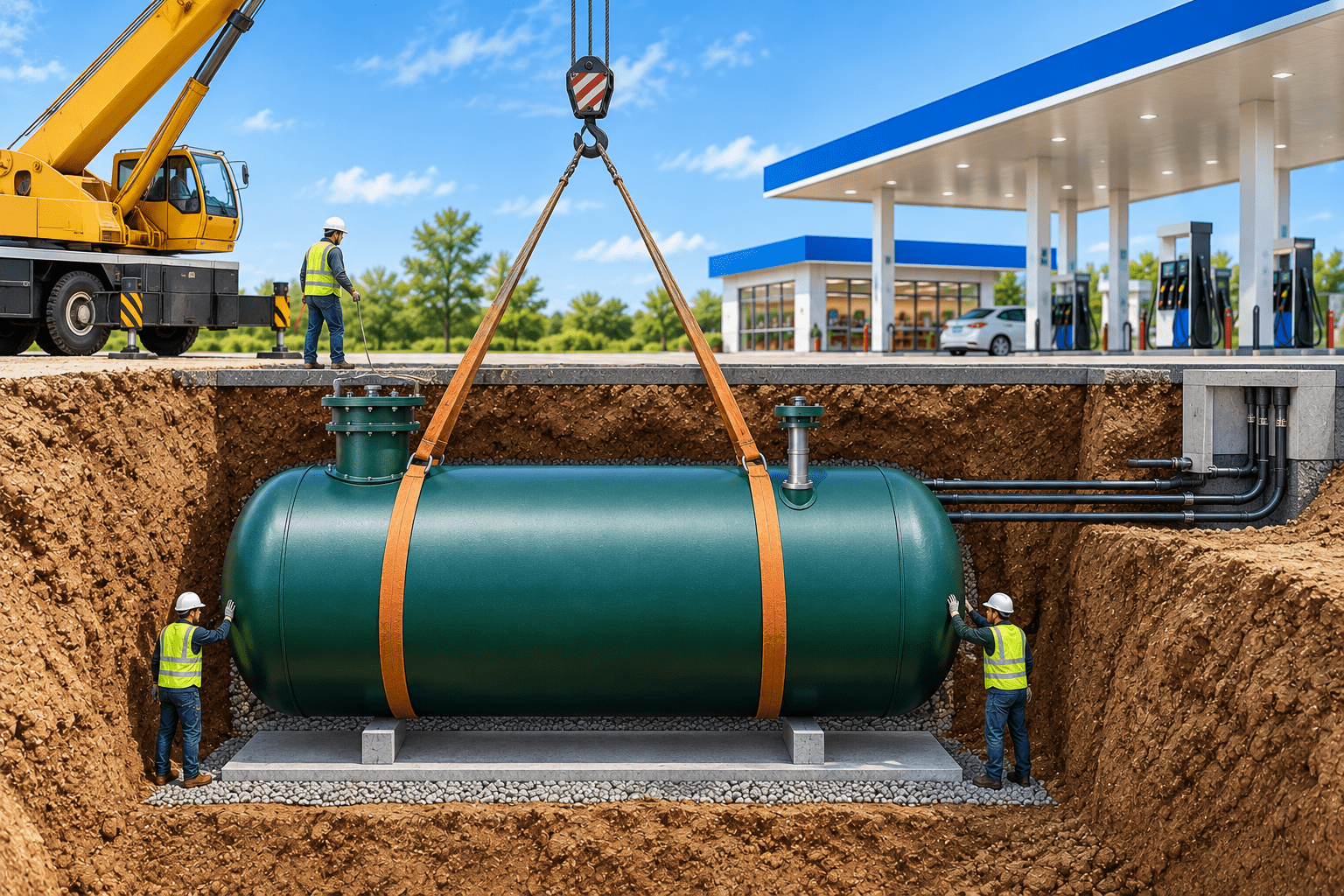
Installing an underground fuel storage tank is a complex engineering process that requires detailed planning, suitable equipment, and careful coordination.
A properly planned installation considers the tank, excavation, soil conditions, groundwater, foundations, piping, monitoring systems, corrosion protection, and operational safety requirements.
Quick Answer: How Is an Underground Fuel Storage Tank Installed?
An underground fuel storage tank installation generally involves:
- Site assessment
- Engineering and system design
- Excavation
- Preparing the tank base
- Tank placement
- Anchoring where required
- Backfilling
- Installing piping and accessories
- Installing monitoring systems
- Testing and commissioning
The exact process varies depending on the project and applicable requirements.
Step 1: Site Assessment
Before excavation begins, the project site should be assessed.
Important factors include:
- Available space
- Soil conditions
- Groundwater
- Existing underground utilities
- Vehicle movement
- Site access
- Drainage
- Required tank capacity
A detailed site assessment helps reduce unexpected problems during installation.
Step 2: Underground Fuel Storage System Design
The engineering team determines the overall system design.
This may include:
- Tank capacity
- Number of tanks
- Tank type
- Fuel type
- Tank location
- Piping routes
- Filling arrangements
- Venting
- Pumps
- Monitoring systems
- Leak detection
The design should be based on the operational requirements of the facility.
Step 3: Excavation
The installation area is excavated to accommodate the underground fuel storage tank.
The excavation must consider:
- Tank dimensions
- Working space
- Foundation requirements
- Backfill requirements
- Safe access
Excavation activities should be carefully managed because soil and groundwater conditions can affect the installation process.
Step 4: Preparing the Tank Foundation
The base of the excavation must be prepared to provide stable support.
The foundation system depends on:
- Tank type
- Soil conditions
- Project design
- Groundwater conditions
A properly prepared foundation helps ensure that the tank remains stable after installation.
Step 5: Tank Placement
The underground fuel storage tank is carefully lowered into the prepared excavation.
Proper lifting equipment and approved lifting procedures should be used.
The tank must be positioned according to the approved engineering layout.
Step 6: Anchoring the Tank Where Required
Groundwater can create buoyancy forces on an underground tank.
Where required, tank anchoring systems may be used to help prevent movement.
The need for anchoring should be evaluated during the engineering and site assessment stage.
Step 7: Backfilling
Once the tank is correctly positioned, suitable backfill material is placed around the tank.
Backfilling should follow the tank manufacturer’s requirements and approved engineering procedures.
Proper backfilling helps:
- Support the tank
- Maintain stability
- Protect the tank structure
Step 8: Installing Fuel Piping
Fuel piping connects the underground storage tank with the fuel delivery and dispensing systems.
The piping system may include:
- Fill lines
- Product lines
- Vent lines
- Connections to pumps
All piping should be installed and tested according to the project design.
Step 9: Installing Monitoring and Leak Detection Systems
Monitoring systems can help operators manage the fuel storage infrastructure.
Depending on the system, monitoring may include:
- Fuel level monitoring
- High-level alarms
- Leak detection
- Tank condition monitoring
These systems can help identify potential problems early.
Step 10: Testing and Commissioning
Before the underground fuel storage system becomes operational, the installation should undergo appropriate inspection and testing.
Testing requirements depend on:
- Tank system
- Project specifications
- Applicable regulations
- Equipment manufacturer requirements
After successful testing and approval, the system can be prepared for operation.
Common Challenges During Underground Fuel Storage Tank Installation
Groundwater
High groundwater levels can affect excavation and tank stability.
Poor Soil Conditions
Weak or unstable soil may require additional engineering measures.
Limited Site Access
Transporting and positioning large tanks can be challenging in restricted locations.
Existing Utilities
Underground utilities must be identified before excavation.
Drainage
Poor drainage can affect the installation area and surrounding infrastructure.
Important Safety Considerations
Underground fuel storage tank installation should only be performed by qualified and experienced professionals.
Important considerations include:
- Site-specific risk assessment
- Safe excavation practices
- Proper lifting procedures
- Fuel compatibility
- Environmental protection
- Appropriate testing
- Compliance with applicable requirements
Frequently Asked Questions
How deep are underground fuel storage tanks installed?
Installation depth depends on the tank design, site conditions, engineering requirements, and applicable standards.
How long does installation take?
The timeline depends on factors such as tank size, site conditions, excavation requirements and the complexity of the complete fuel storage system.
Why is groundwater important?
Groundwater can affect excavation and may create buoyancy forces that need to be considered during system design.
Is leak detection required?
Monitoring and leak detection requirements depend on the system design and applicable project requirements.
Conclusion
Underground fuel storage tank installation requires careful planning from the initial site assessment through final testing and commissioning.
The quality of excavation, foundation preparation, tank placement, anchoring, backfilling, piping and monitoring installation can all affect the long-term performance of the system.
A professionally engineered approach helps ensure that the underground fuel storage infrastructure is designed around the site’s operational and environmental requirements.